

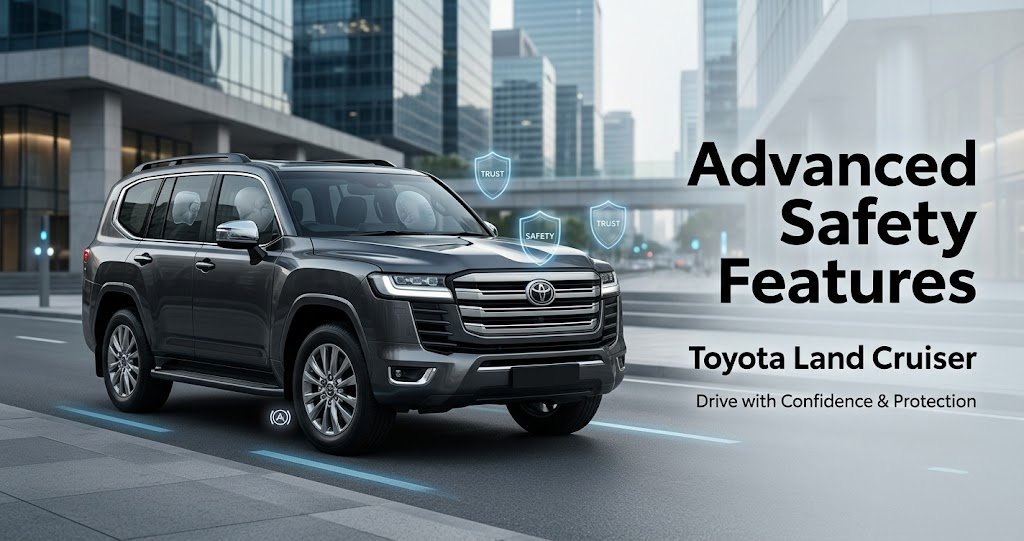
When it comes to conquering challenging roads, whether it’s a rocky mountain trail, a flooded desert track, or a steep muddy slope, the Toyota Land Cruiser is considered a legend.
The Toyota Land Cruiser pairs its legendary off-road capability with a consistent record of setting the safety benchmark in the most challenging environments.
Find below the advanced safety features that make the Toyota Land Cruiser one of the safest vehicles on and off the road.
Toyota Land Cruiser Safety Features
1. Toyota Safety Sense (TSS)
The Toyota Land Cruiser comes equipped with Toyota Safety Sense (TSS), a suite of intelligent safety technologies designed to assist the driver and prevent accidents before they happen.
Key TSS features on the Land Cruiser include:
- Pre-Collision System (PCS): Detects vehicles and pedestrians ahead and automatically applies the brakes if a collision risk is identified.
- Lane Departure Alert with Steering Assist: Keeps the vehicle centred within its lane and provides corrective steering if it detects unintentional lane drift.
- Radar Cruise Control: Automatically adjusts your speed to maintain a safe following distance from the vehicle ahead, even in stop-and-go traffic.
- Automatic High Beam: Uses cameras and sensors to monitor the road ahead and automatically adjusts high-beam headlights to avoid blinding oncoming traffic.
These features work seamlessly together to reduce driver fatigue and significantly cut down the risk of collisions, whether you are on a busy highway or a remote trail.
2. Multi-Terrain Monitor
One of the greatest dangers of off-road driving is not knowing what lies beneath or around your vehicle. The Toyota Land Cruiser’s Multi-Terrain Monitor addresses this brilliantly.
The system uses multiple cameras placed strategically around the vehicle to give you a real-time, 360-degree bird’s-eye view of your surroundings. On the central display, you can see:
- The exact position of your tyres in relation to rocks, ledges, and uneven surfaces
- The angle and gradient of the terrain directly ahead of and behind your vehicle
- Potential obstacles that are hidden from the driver’s direct line of sight
This feature is invaluable when navigating narrow mountain passes, river crossings, or rocky descents where a single misjudged move could be dangerous. The Multi-Terrain Monitor essentially extends your vision beyond what the human eye can see from the driver’s seat, giving you confidence and control in every manoeuvre.
3. Crawl Control
Off-road driving demands a level of throttle and brake precision that is nearly impossible to maintain manually, especially over extended distances. The Land Cruiser’s Crawl Control system takes this challenge off your plate entirely.
Similar to cruise control but built specifically for off-road conditions, Crawl Control automatically manages engine output and braking to maintain a slow & steady speed across five different terrain modes:
- Mud and Sand
- Loose Rock
- Rock and Dirt
- Mogul
- Snow
This means the driver can focus entirely on steering and navigation, without worrying about wheel spin, excessive braking, or losing traction. On steep descents in particular, this system prevents the vehicle from gaining dangerous speed, ensuring a safe and controlled descent every time.
4. Kinetic Dynamic Suspension System (KDSS)
The Toyota Land Cruiser’s Kinetic Dynamic Suspension System (KDSS) is one of the most sophisticated stability systems available in an SUV today. While conventional suspension systems can compromise between on-road stability and off-road articulation, KDSS delivers both simultaneously.
Here is how it works:
KDSS uses hydraulic cylinders connected to both the front and rear stabiliser bars. When off-road, the system automatically decouples the stabiliser bars, allowing the wheels to move more freely and maintain contact with the ground. When back on the road, it reconnects them to provide the firm, stable ride you expect from a premium SUV.
The result?
The Land Cruiser remains planted, balanced, and controlled across every type of terrain, significantly reducing the risk of rollovers and loss of control.
5. Vehicle Stability Control (VSC) and Active Traction Control (A-TRC)
Two of the Land Cruiser’s most fundamental safety pillars are its Vehicle Stability Control (VSC) and Active Traction Control (A-TRC) systems. Together, they form an invisible safety net that constantly monitors and corrects your vehicle’s behaviour.
Vehicle Stability Control (VSC)
- Monitors vehicle speed, steering angle, and lateral movement 50 times per second
- Detects when the vehicle is beginning to skid, oversteer, or understeer
- Applies targeted brake pressure to individual wheels to restore stability instantly
Active Traction Control (A-TRC)
- Monitors wheel spin in real time across all four wheels
- Reduces engine power and applies braking to spinning wheels to transfer torque to wheels with grip
- Keeps the vehicle moving forward even when individual wheels lose traction on loose or slippery surfaces
Together, VSC and A-TRC ensure that even in the most slippery, unpredictable conditions, the Toyota Land Cruiser responds calmly and correctly.
6. Downhill Assist Control (DAC)
Descending a steep hill in a heavy SUV is one of the most intimidating driving scenarios for any driver. The Land Cruiser’s Downhill Assist Control (DAC) makes this not just manageable, but genuinely safe.
DAC automatically applies the brakes on all four wheels to maintain a slow & consistent speed when descending steep grades, even without the driver pressing the brake pedal. This prevents the vehicle from gaining uncontrolled momentum, reduces the risk of wheel lockup, and allows the driver to focus on steering their way safely down the slope.
Whether you are navigating a steep dune descent in a desert or a slippery mountain trail after rain, DAC ensures you reach the bottom of every hill safely and in full control.
7. Structural Safety
Beyond active safety systems, the Toyota Land Cruiser’s safety begins with its very structure. Toyota engineers the Land Cruiser’s body and frame to protect occupants in the event of a collision, using a combination of:
- A high-tensile steel body-on-frame chassis that absorbs and distributes impact energy away from the passenger cabin
- Multiple airbags, including front, side, curtain, and knee airbags, to protect all occupants in a crash
- Zone Body Construction with crumple zones that collapse in a controlled manner to reduce the force transmitted to passengers
- Reinforced door frames and pillars that maintain cabin integrity even in a rollover situation
This structural toughness is one of the reasons the Land Cruiser earns consistently high safety ratings.
The Toyota Land Cruiser has spent decades earning its reputation as the world’s most trusted off-road vehicle. And central to that reputation is its unwavering commitment to keeping every occupant safe, whether they are on a highway in the city or on a trail deep in the wilderness.
Visit Galaxy Toyota today to check out the Toyota Land Cruiser price and features in Delhi.
Frequently Asked Questions (FAQs)
Q1. What safety features does the Toyota Land Cruiser have for off-road driving?
The Toyota Land Cruiser offers a comprehensive set of off-road safety features, including Crawl Control, Multi-Terrain Monitor, Downhill Assist Control (DAC), Active Traction Control (A-TRC), and the Kinetic Dynamic Suspension System (KDSS). These systems work together to keep the vehicle stable, controlled, and safe across mud, rock, sand, snow, and steep gradients.
Q2. Does the Toyota Land Cruiser have automatic emergency braking?
Yes. The Land Cruiser is equipped with a Pre-Collision System (PCS) as part of the Toyota Safety Sense (TSS) suite. This system uses radar and camera technology to detect potential collisions with vehicles and pedestrians, and automatically applies the brakes to reduce the severity of or prevent a collision entirely.
Q3. How does Crawl Control work on the Toyota Land Cruiser?
Crawl Control is an off-road-specific system that automatically regulates engine throttle and braking to maintain a slow & constant speed across challenging terrain. The driver selects from five terrain modes (Mud and Sand, Loose Rock, Rock and Dirt, Mogul, and Snow), and the system handles speed management, freeing the driver to focus solely on steering.
Q4. Is the Toyota Land Cruiser safe for family use on long road trips?
Absolutely. The Land Cruiser is designed with family safety at the forefront. It offers multiple airbags, Lane Departure Alert, Radar Cruise Control, a rigid body-on-frame structure with crumple zones, and a spacious cabin with three rows of seating. Whether it is a highway road trip or an adventurous trail drive, the Land Cruiser provides comfort and safety for the entire family.
Q5. Does the Toyota Land Cruiser have a 360-degree camera?
Yes. The Land Cruiser’s Multi-Terrain Monitor uses multiple cameras positioned around the vehicle to provide a comprehensive view of the surroundings, including a bird’s-eye overhead view and tyre-position views. This is particularly useful when navigating tight off-road trails, parking in confined spaces, or manoeuvring over obstacles where direct visibility is limited.
Galaxy Toyota Showroom in Delhi
Galaxy Toyota is an authorized Toyota dealer offering the latest Toyota models at the best prices in Delhi. You can check out your favorite models, their features, price, and ongoing deals at the dealership.
Visit the Galaxy Toyota showroom today!